

Don’t Believe a Word
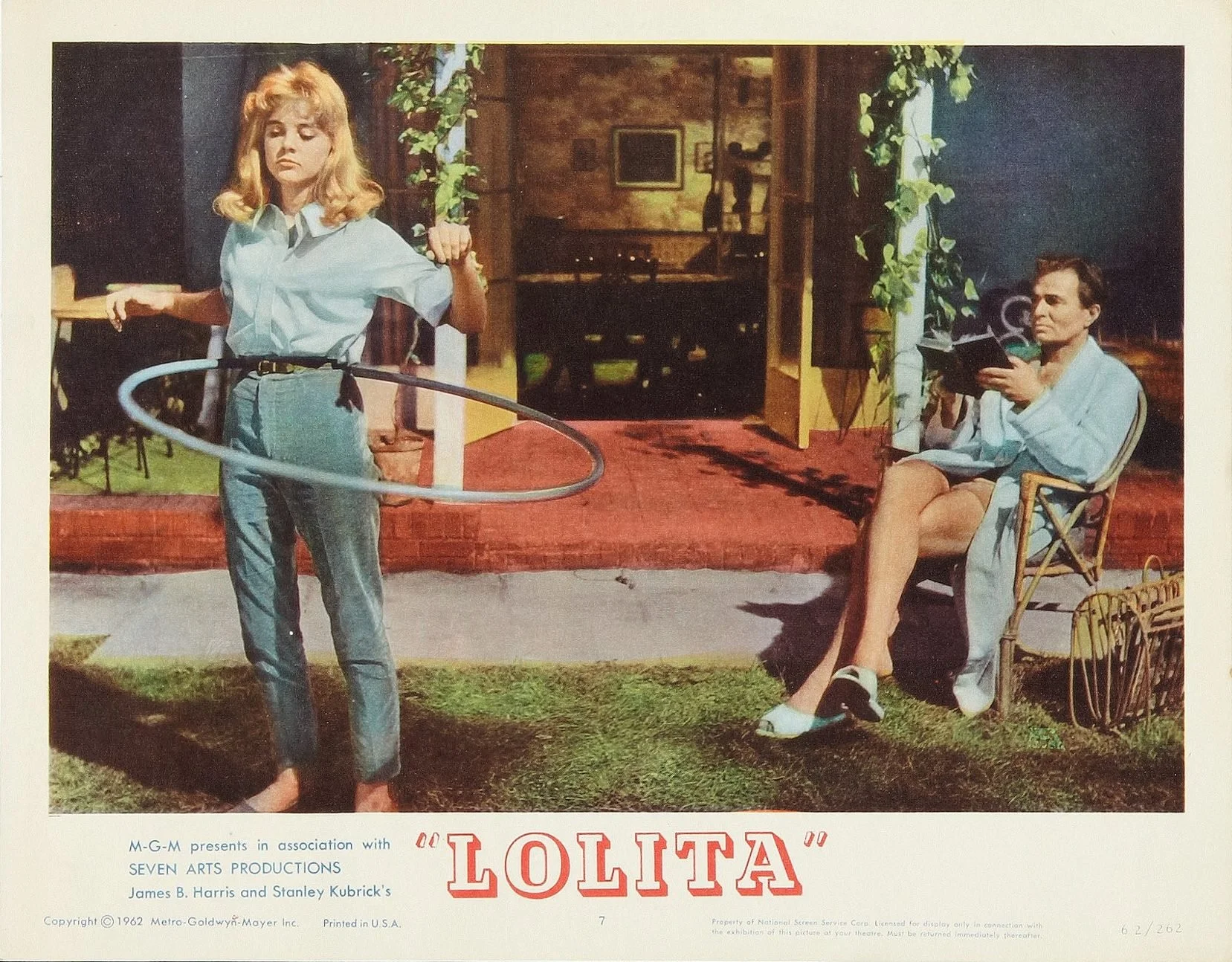
It was like this…Humbert Humbert, a monster and a liar begs our forgiveness
We always know. Really. Deep down.
Somewhere in the first pages, we feel it—the slight misalignment, the varnish, the performance. The story is too polished. Or too hysterical. Or too morally certain. Something doesn’t sit cleanly.
Whatever it is, there’s always that little “Eh?” ringing at the back of our brains. And yet, we keep reading. Why? Why do we love the narrator who cannot be trusted? Who are they kidding—themselves, us, or both?
Perhaps the better question is this: Why is it so fun to ride along with the untruth?
Who Are They (and You) Kidding?
An unreliable narrator is rarely, if ever, just mad. Or just evil. Or just mistaken. They are simply doing what we readers—especially those of us who are writers—do every day: they choose their version of reality and declare it truth.
What they don’t say is often the sneakiest part. Manipulation is frequently an act of omission; they don’t tell you black is white, they simply refuse to mention colour at all. They edit reality to suit their inner story.
And who are they trying to fool? More often than not, it’s themselves. And we, perversely, love to join in.
A Rogue’s Gallery
Presenting some of literature’s greatest lies—and the lying liars who told them.
(Note: Spoilers ahead. Also, these are merely our opinions. Talk about unreliable narrators!)
The Liar-Seducer
“You can always count on a murderer for a fancy prose style”
In Lolita, Humbert Humbert confesses everything. Sort of. He tells us he is monstrous, yet as he confesses, he seduces. He aestheticizes. He polishes horror into lyricism. One of literature’s greatest grotesques seeks absolution with the ultimate non-apology, and don’t we see a lot of those around these days?
He isn’t trying to trick us into thinking he’s innocent; he’s smart enough to know that ship has sailed. He is trying to trick us into buying his version of events—a much less bitter pill for him to swallow. It helps the shame go down. He reframes obsession as love and possession as poetry. Nabokov turns his anti-hero into a deluded fool, desperate for our help to prove he’s “not quite so bad.”
Does sharing the shame let Humbert off the hook? He certainly hopes so, and he has a twin in Alex DeLarge from A Clockwork Orange, where Burgess (a noted Nabokov fan) often has his own anti-hero playing to the gallery:
“And what of me, brother sir? Speak up for me. I’m not so bad—I was led on by the treachery of others, sir.”
The Dissolving Man
Patrick Bateman in American Psycho is a horrific piece of work, embarking on a rampage of murder that even a shallow, consumerist New York can’t begin to fathom. Or, as you’ll read a lot in this piece, is he?
As he retreats into scrub routines and Phil Collins albums, is violence the only way to stand out from the bland corporate drones he walks among? Consumer brands replace identity. Violence becomes interchangeable with dinner reservations. His confession dissolves into white noise. Does he, in fact, actually exist?
Revisiting the novel recently, it feels like a sophisticated, prescient look at the “manosphere” and misogynist culture, not just the consumerism it also confronts. Bateman’s psyche is a vicious, delusional cipher. His desperation to usurp his nemesis, Paul Allen—who simply has a little more than he does—proves Bateman is, in himself, nothing. In a world constructed of luxury vodka, business card typography and blandly interchangeable club-goers, his desire to be a “real” person fails. Even when he wants to reveal himself, the revelation rings hollow.
“This confession has meant nothing.”
Bateman is trapped in a world filled with “Exit” signs that lead nowhere. It culminates in one of our favourite closing lines: “THIS IS NOT AN EXIT.”
He’s behind you…or is he? The Turn of the Screw
Twists and Turns
In The Turn of the Screw, the Governess is convinced.
There are ghosts, and they are real. The children have been corrupted by them. She alone sees clearly. That certainty is what disturbs us the most.
Ghosts don’t exist. We know this. We’re rational readers. But why are we doubting ourselves? Is it because she is the only narrator we have, and she believes. One hundred percent.
Is she protecting the children from spectral danger — or is she the danger? Perceiver of truth,…or mentally ill? We’re never really sure, but whatever the truth of her version, one way or the other, there is danger everywhere.
“She was there, and I was justified; she was there, and I was neither cruel nor mad.”
The Lunatic with the Truth
Chief Bromden in One Flew Over the Cuckoo’s Nest sees machinery in the walls. He calls it “The Combine.” He believes the world is mechanized, controlled, and processed. But he would say that, right? Him being “crazy” and all that? And yet, in a hospital full of the marginalised, the mute giant might be the only one seeing the actual truth. The inmates aren’t mad; they are simply struggling within systems others refuse to see.
And what of McMurphy? The “sane” man who feigns insanity to escape prison, only to find the lie becomes a trap that destroys him.
“But it’s the truth, even if it didn’t happen.”
That Chief, is the most reliable “unreliable” thing we’ve ever read.
The Incredible Shrinking Woman
We never learn the name of the narrator in Rebecca. She does not lie flamboyantly or build grand fictions. Instead, she diminishes herself. She systematically erases her own presence in the shadow of the late Rebecca, mythologising another woman into something supernatural. It is her insecurity—her constant “absence”—that distorts Manderley into something haunted by... nothing?
“I realise, every day, that things I lack—confidence, grace, beauty, intelligence, wit – Oh, all the qualities that mean most in a woman – she possessed.”
The Real Thing?
One of our favourite hokum-conjurers is the Reverend Cherrycoke from Thomas Pynchon’s Mason & Dixon. Desperate to stay with relatives during a cold winter*, he spins a ridiculous web: a mechanical duck in love with a French chef (of ducks), albino Swedes who love their axes more than women, and mashups of various fairy tales and folklore. We of course meet Pynchon’s usual cavalcade of absurd characters (including a sailor is very obviously Popeye, probably), as we follow two British astronomers, dividing a nascent country into literally, two.
It’s nuts. It makes no sense. Not a word of it is true, and yet we hang on every syllable. Now that is storytelling.
“I am often thinking of the better story because the actual story is so often boring.”
*any similarity between this and our very own Narcisa is because we stole the idea, plain and simple.
Bits and Pieces
In The Handmaid’s Tale, Offred openly admits she cannot be counted on for the whole truth, and sometimes it’s not even close.
She retells scenes differently. She imagines alternate outcomes and suggests they could also have happened at the same time.
She comes right out and says: ‘this may not have happened exactly this way’.
But here, unreliability is not deceit, it is the fruit of trauma. To remember exactly is to re-experience, and as we discover more and more of the world of Gilead, we start to sympathise with the mental distance she seeks. We forgive her untruths, because we too would want to escape. Who wouldn’t?
Memory is often unstable because, survival? Survival demands revision.
“Aunt Lydia did not actually say this, but it was implicit in everything she did say"
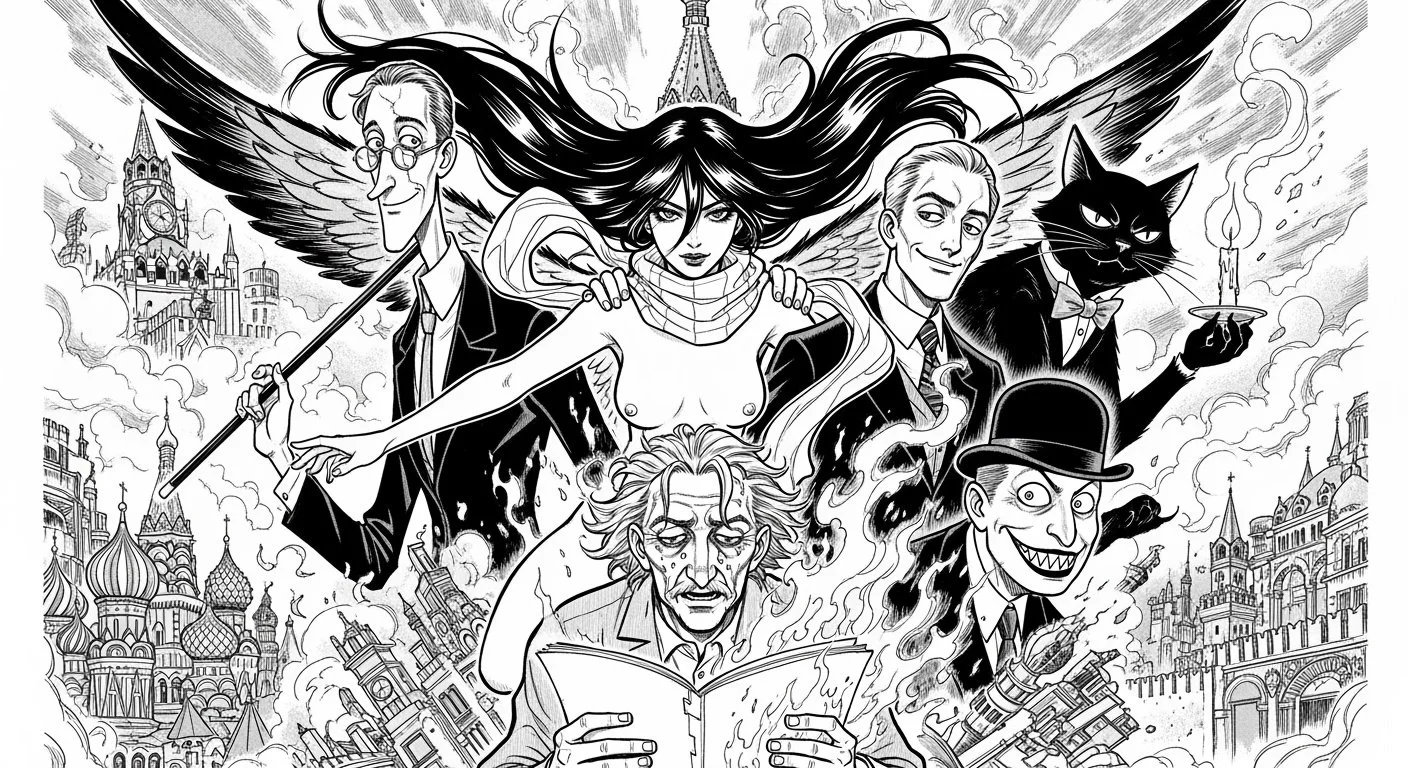
The Madness of the Master & Margherita, and it’s all true (apparently.)
Finally! A Real Truth Teller
Just a shame it’s the devil!
Following on from the Faust quote…
“I am part of that power which eternally wills evil and eternally works good”
…let’s introduce, Woland from The Master and Margarita. Yes that one, the ‘hope you guess my name’ from the Rolling Stones one. Satan is here, on Earth, but why?
Upon his arrival in Moscow…
He destabilises the entire city.
He exposes hypocrisy.
He rearranges lives.
But, and crucially…
He does not lie.
He is not unreliable at all, for instance, he tells the first people he meets, exactly how the encounter between Yeshua and Pilate went, because he was there. It turns out that the Devil, ironically, is affronted at the very suggestion of an untruth! How very dare they!
He is truthful. Just, corrosively so. In a Moscow riddled with secrets, hypocrisy, fear, corruption, lies and terror — from a government that has created exactly those conditions so as to control its people? Well, then the most mischief you can make is to do something no one else can.
Tell the truth.
Because if you do, literally, all hell will break loose.
“Follow me, reader! Who told you that there is no true, faithful, eternal love in this world! May the liar's vile tongue be cut out!”
Printing the Legend
Switching to cinema, in Unforgiven, there is a writer who trails gunmen, polishing their reputations into shining legend. even if it’s mostly bullshit.
This instinct echoes an older cinematic line from The Man Who Shot Liberty Valance:
When the legend becomes fact, print the legend.
In one powerful and pivotal scene, Gene Hackman’s Sherrif Lil’ Bill mercilessly exposes the truth of gunfighting legend English Bob to the writer Beauchamp. His most famous fight? It was no noble demonstration of the gunslinging art. A drunkard Bob shot an unarmed man, drawing on him from behind, missing him several times before finally killing him because his rival’s gun had jammed and he could not shoot back. Lil’Bill mockingly changes his name from famous moniker ‘Duke’ to “ The Duckof Death”.
Unforgiven’s script then, is a masterful tale about the messy and brutal truth of the West. It’s a period that is still eulogised, but with a lot of the sharper edges sanded off, lynching, violence, the destruction of native land and people, religious persecution and the subjugation of women? Best forgot.
But they are always there, those inconvenient yet persistent truths. Hell, even John Wayne had his cynical moments.
For this part, we’ll leave you with Unforgiven’s haunting coda.
Some years later, Mrs. Ansonia Feathers made the arduous journey to Hodgeman County to visit the last resting place of her only daughter. William Munny had long since disappeared with the children... some said to San Francisco where it was rumored he prospered in dry goods. And there was nothing on the marker to explain to Mrs. Feathers why her only daughter had married a known thief and murderer, a man of notoriously vicious and intemperate disposition.
A Very Crowded Castle
And then, there is our very own Narcisa. We think we’re writing a great story, but who’s telling it? 150,000 words in, and even we aren’t entirely sure.
Is it the Aunt, with her careful framing and manipulative omissions? Is it Narcisa herself, who embellishes, performs, and glories in her own theatrics? (The book is named after her, after all—is that a clue? Maybe.)
Or is it the Castle itself, shifting and swelling in the dark?
We see the narrative baton switch like a relay in every rewrite. With every change of narrator, power shifts. Control is grasped or ceded. Red herrings are made redder—or simply eaten. Many characters are vying to control the story of our “blundering nincompoop” heroin, including us.
But she is a slippery so-and-so, but we do know one thing. One day soon, it will all be down to her.
Bu we get ahead ourselves, for it all started simply, with a worldly, troubled Aunt needing, just like the Rev Cherrycoke, a place to stay. To keep her bed and board, she must concoct a tale that will stretch across many, many nights.
And so, like her Arabian Nights counterpart, perhaps one of the greatest unreliable narrators of all time, her story starts simply enough: a girl is running...
No, more.
Running for her life!
So Scheherazade began…
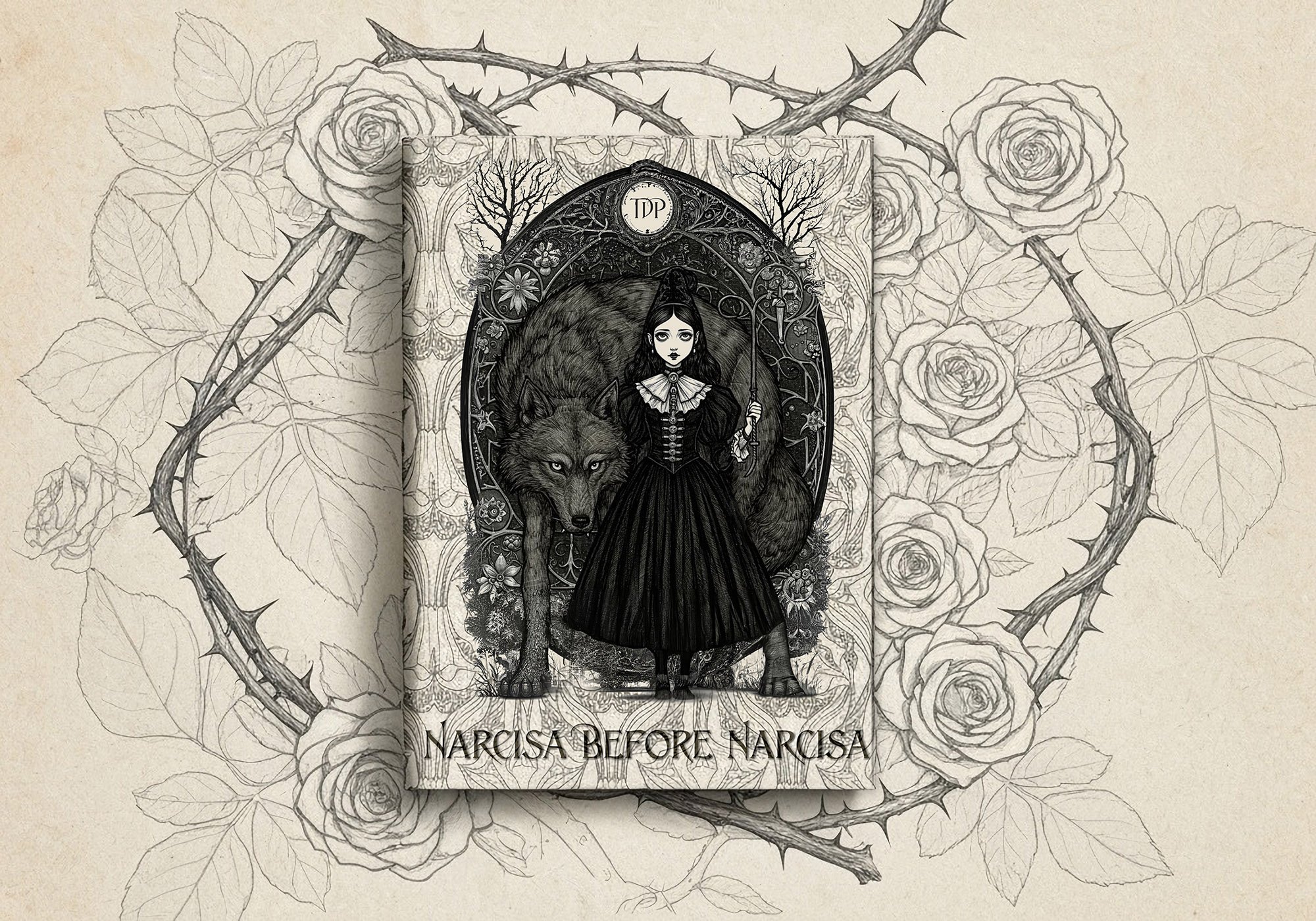
Read the first chapter of Narcisa Before Narcisa here
Pants on Fire…
Why is it such a joy to hide in the liars? Because they mirror what we do every day. No one recounts their actual life without rearranging it.
We minimise failures.
We elevate wounds.
We soften cruelties.
We big-up heroics.
We tell ourselves a version of our life that we can live with.
And when we do the same in our work, we hope our readers follow suit, however far fetched it all is.
Writing makes liars of us all because writing is selection. And selection is distortion.
The moment you begin a sentence — “Honestly, this happened…” — you have already a Rashomon moment, because you can immediately think “but, well maybe not exactly like this.”
Last word? Well, we started thinking about this whole thing because we were spinning Thin Lizzy’s Don’t Believe a Word in the office. So really, what better sign off to this whole piece than from the pirate poet himself, Phil Lynnot?
Don't believe me if I tell you
Not a word of this is true
Don't believe me if I tell you, especially if I tell you
I'm in love with you
Don't believe a word
For words are so easily spoken
And your heart is just like that promise
Made to be broken
Don’t indeed…